

That Just Happened: Lesson Demonstration and Debrief
Posted in James Madison Legacy Project Expansion We the People: National Symposium on Civic Education
Kelly Reichardt, Center for Civic Education; Anna Ballard, Center for Civic Education
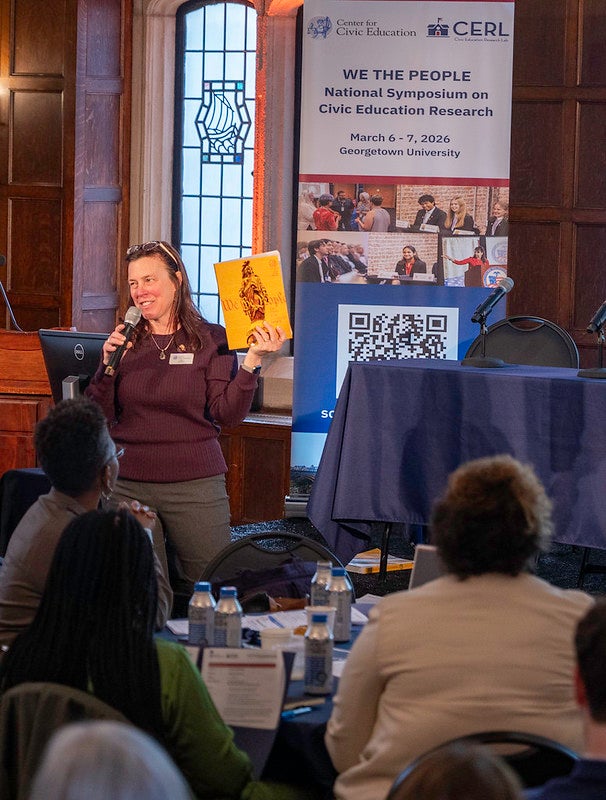
Kelly Reichardt and Anna Ballard presented a newly designed JMLPE lesson, “Federalism and You”, as an example of the updated resources available for teachers through JMLPE. Ballard and Reichardt taught the symposium participants (as if they were their students) using the 5E’s model of instruction—engage, explore, explain, elaborate, and evaluate—to explain how federalism shapes public policy and individual lives.
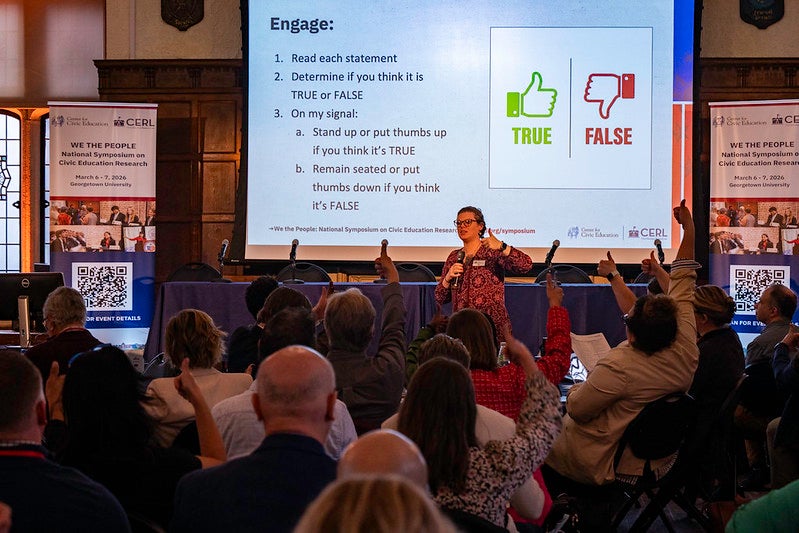
First, they asked a series of questions about driving policies in various states. Did you know that…
- In New Jersey, drivers are not allowed to pump their own gas?
- In Alaska, drivers are required to carry tire chains during the winter?
- In Montana, there is no statewide law requiring motorcycle helmets for adults?
- In Florida, a driver under 19 cannot drive between 11:00 p.m. and 6:00 a.m. without supervision?
Next, the lesson explored federalism vocabulary. The approach, which provided handouts alongside on-screen definitions and examples, incorporated Universal Design for Learning strategies that support the success of all students. Students can work through the activity in groups using annotatable resources, and the terms are presented with both written and visual definitions to support diverse learners.
Finally, they posited the question: “How much power should states have in a united nation?” Each JMLPE lesson includes an inquiry question designed to encourage critical thinking and prepare students to develop an argument, as they will in the simulated congressional hearing. Students are given a collection of primary sources related to state-level driving age regulations to help them respond to the question; they examine these sources, interpret data, and draw connections across sources to deepen their understanding of the issue in a context relevant to their lives. Student learning is assessed by evaluating their answer to the inquiry question.
By connecting federalism to policies students can recognize, providing multiple ways to engage with key vocabulary, and building toward an evidence-based response to an inquiry question, the lesson shows how teachers can make complex constitutional concepts accessible while still holding all students to high standards.