

It’s Elementary: Reclaiming the Civic Mission through Literacy Integration
Posted in James Madison Legacy Project Expansion We the People: National Symposium on Civic Education
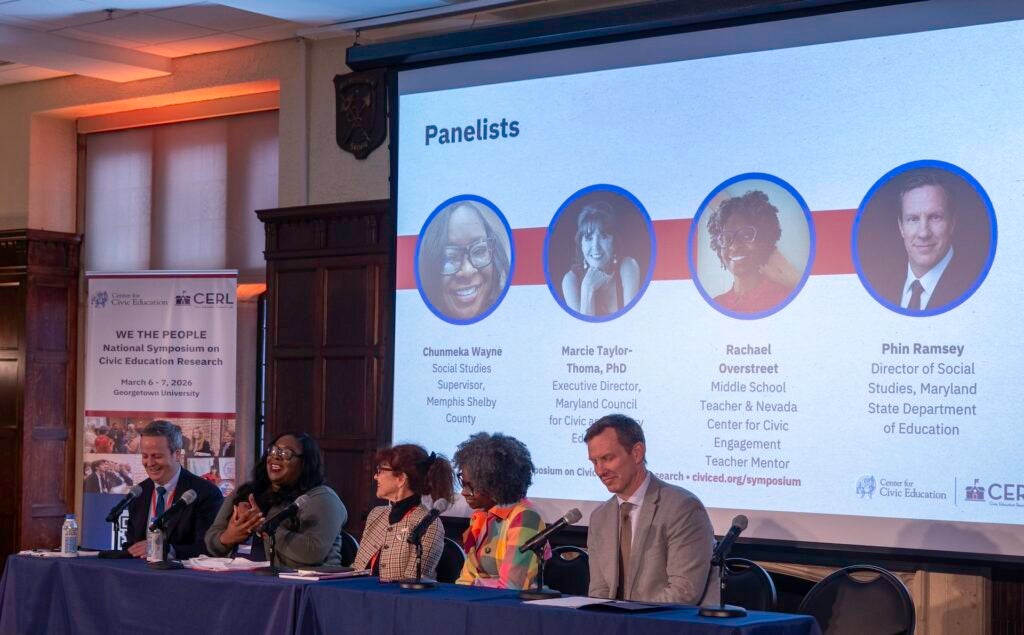
Scott Abbott, Delaware Center for Civics Education; Chunmeka Wayne, Memphis Shelby County; Marcie Taylor Thoma, Maryland Council for Civic and History Education; Rachel Overstreet, Nevada Center for Civic Engagement; Phin Ramsey, Maryland State Department of Education
by Scott Abbott
The “It’s Elementary: Civics and Literacy” panel shared their insights into the ways that civics and literacy intersect in the elementary grades. This convening provided a critical platform to address the pervasive gaps that lead to the marginalization of social studies and civics at the elementary level. Yet, as the panelists shared, better paths forward exist. During our discussion, panelists presented evidence that civics should not be viewed as a competitor to literacy, but as an engine behind its development, one that should work in tandem with other subjects, such as English Language Arts and science.
The discussion began by acknowledging a sobering reality: the marginalization of social studies in elementary grades. Since the enactment of No Child Left Behind in 2001, at least 44% of school districts have reduced instructional time for social studies to accommodate the demands of math and English Language Arts (ELA), and this trend disproportionately impacts our most vulnerable learners. The result is a narrowing of the curriculum that leaves students without the knowledge or agency necessary for participatory citizenship.
Panelists repeatedly mentioned the role that social studies and civics can play in supporting literacy outcomes. Chunmeka Wayne noted that when “students are afforded the opportunity to engage with civic content, you can easily pull out those literacy concepts, practices, and skills.” This kind of integration happens frequently during students’ preparation for the We the People program’s Simulated Congressional Hearings. “Reading comprehension depends heavily on what students already know about the world…when students learn about democratic institutions and historical events, they develop the knowledge and vocabulary that helps them to make sense of increasingly complex text,” said Phin Ramsey. Ramsey also referenced the 2020 Fordham Institute study by Adam Tyner and Sarah Kabourek in which they found that “increased instructional time in social studies – but not in ELA – is associated with improved reading ability.” (Social Studies Instruction and Reading Comprehension, p.27). This connection between civics and literacy development makes sense, especially since “Robert Marzano found that 55% of academic language came from social studies,” according to Wayne.
While school administrators recognize the importance of social studies, scheduling pressures sometimes lead them to attempt to capture its benefits through integration with other subjects. Panelists noted that the research of Linda Bennett and Elizabeth Hinde (Becoming Integrated Thinkers, 2015) shows attempts at integration often lead to fractured, stealthy, or non-existent social studies instruction. “Healthy integration is not reading a story about George Washington’s teeth,” said Marcie Taylor Thoma. But panelist Rachael Overstreet expressed hope that combining access to high-quality curricular resources like the We the People book with professional development, assessment, and scheduling policies that preserve time for daily social studies instruction can support the development of civic knowledge, skills, and dispositions for elementary students.
Return to Session Summaries
Watch the It’s Elementary presentation:
Video link: https://www.youtube.com/live/4pHBfDpJdg0?si=vD2G9ONNONxqFamA&t=8260