

Why Civic Education Matters Now
Posted in James Madison Legacy Project Expansion We the People: National Symposium on Civic Education
Diana Owen, Civic Education Research Lab
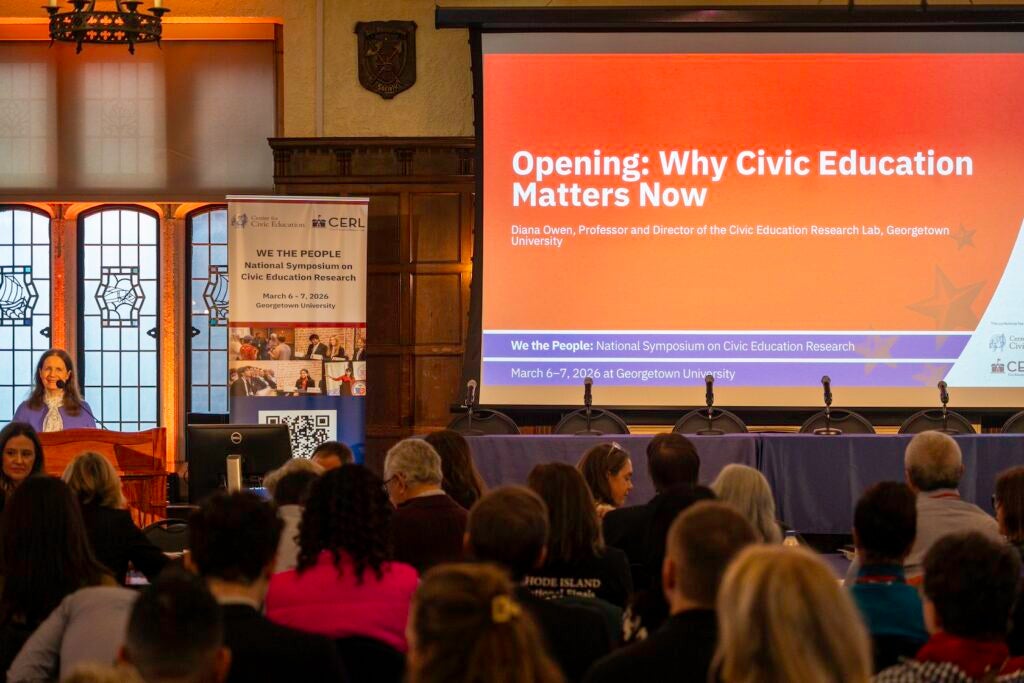
Strengthening civic education requires more than strong programs. It requires rigorous evidence about what works, for whom, and under what conditions. The James Madison Legacy Project Expansion (JMLPE) illustrates how research can support both improvement and scale.
From 2022 to 2025, the Civic Education Research Lab (CERL) conducted a multi-phase evaluation of JMLPE, combining qualitative research with randomized controlled trials. This approach enabled collaboration between researchers and practitioners, using evidence to measure outcomes and refine curriculum and instruction over time.
The findings provide strong evidence that high-quality civic education improves student outcomes. Students participating in the We the People curriculum demonstrated greater gains in civic knowledge than their peers in traditional civics courses. These gains were especially important for students with disabilities and English learners.
The impact also extends beyond knowledge. Students reported greater interest in public affairs, increased attention to political information, and stronger beliefs in their ability to influence government. They developed competencies including communication, civil discourse, and media literacy, and were more likely to express intentions to engage in civic life.
“We discovered that the We the People curriculum significantly improved students’ academic performance in civics and prepared them for community life and responsible citizenship.”
– Diana Owen
JMLPE also demonstrates how evaluation data can be used to explore deeper questions about civic learning. Analysis of the data shows a positive relationship between civic knowledge and communication and civil discourse skills. Students with higher knowledge scores tend to demonstrate stronger communication skills, with similar patterns across student groups.
These findings point to a broader role for research in civic education. It allows us to move beyond whether programs work to ask more precise questions. How does civic knowledge support the development of key skills? Which instructional approaches strengthen communication and engagement? How do outcomes differ across student groups and grade levels? And how do classroom experiences connect to broader processes of political socialization?
By grounding these questions in evidence, research provides a clearer path for improving civic education and expanding access to high-quality learning experiences.
Return to Session Summaries
Watch the Why Civic Education Matters Now presentation:
Video link: https://www.youtube.com/live/30QpTDGKkJQ?si=nxeUE8euB1ed-gjy&t=3625