

Who Governs the Algorithm: Civic Education, AI & Democracy, and AI is here!
Posted in James Madison Legacy Project Expansion We the People: National Symposium on Civic Education
Aruna Patel, Center for Civic Education; Jeffrey Livingston, EdSolutions; Zachary Cote, Thinking Nation; Mike Kentz, AI Literacy Partners; Zarek Drozda, Data Science 4 Everyone, Michael Colatruglio, Maryland; Carly Muetterties, Common Good; Timothy Lent, Quill.org; Ed Fickley, Tennessee
By Aruna Patel
The AI session at the We the People National Symposium highlighted a central tension shaping how educators approach artificial intelligence in schools: whether to prioritize access or protection. On one hand, panelists argued that limiting AI use in classrooms risks deepening existing inequities. Students in more affluent communities already have access to these tools at home, while for many others, school may be their only point of exposure. From this perspective, restricting AI in education could unintentionally deny students the opportunity to develop skills essential for future economic and civic participation.
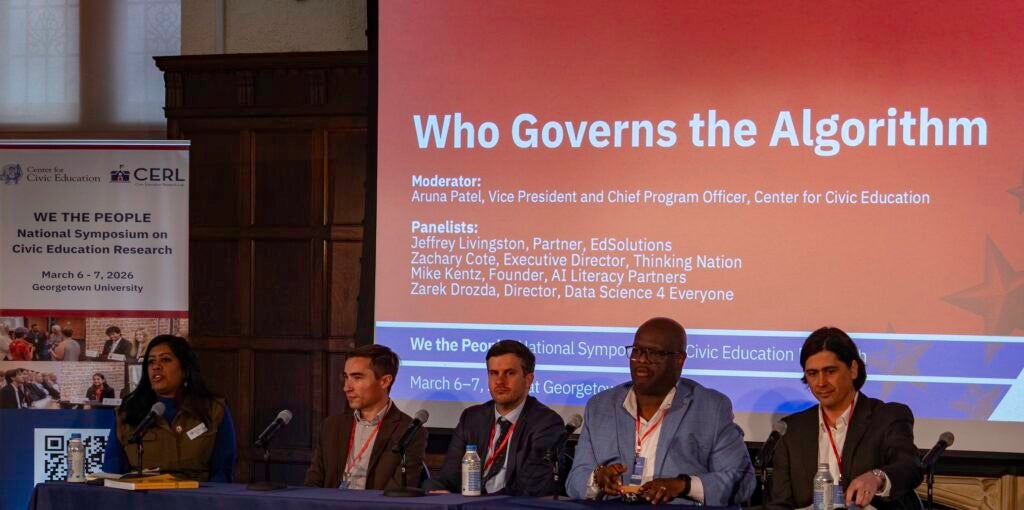
At the same time, others emphasized the importance of caution, noting that AI, particularly general-purpose tools, can undermine critical thinking if introduced too early or without structure. Because these tools can “offload” cognitive work, there is concern that students may rely on them before developing foundational skills in reasoning, writing, and analysis. This tension suggests that the question is not simply whether to use AI, but how and when.
Despite these differences, several shared principles emerged. Panelists highlighted the importance of “narrowly applied AI,” where tools are intentionally designed and used for specific learning goals rather than as open-ended substitutes for thinking. They also emphasized the need for strong AI literacy, ensuring that students understand that these systems are not neutral or magical, but are built on data, shaped by human decisions, and prone to error and bias. A key shift in the conversation was the framing of AI as a civic issue rather than solely an ethical or instructional one. This reframing invites students to grapple with questions about power, governance, and responsibility: Who designs and controls AI systems? What data are we contributing, and to whom? How might AI exacerbate or reduce inequality? By positioning AI within civic learning, educators can help students engage with real-world tradeoffs and prepare them to participate in shaping the policies and norms that will govern these technologies.
The session also underscored the need to rethink broader educational goals. If information is now instantly accessible, the emphasis must move away from memorization and toward inquiry, analysis, and application. Ultimately, the role of educators is not to have all the answers about a rapidly evolving technology, but to create the conditions for students to think critically, act responsibly, and see themselves as active participants in a society increasingly shaped by AI. As the We the People program continues to grow and adapt to the constitutional issues of our time, this panel highlights that artificial intelligence will undoubtedly become a central thought exercise that students must grapple with.
Return to Session Summaries
Watch the Who Governs the Algorithm: Civic Education, AI & Democracy, and AI is here! presentation:
Video link: https://www.youtube.com/live/4pHBfDpJdg0?si=Lil10rVpLBsr3nNV&t=23087