

Promising Practices in Civic Education for English Learners
Posted in James Madison Legacy Project Expansion We the People: National Symposium on Civic Education
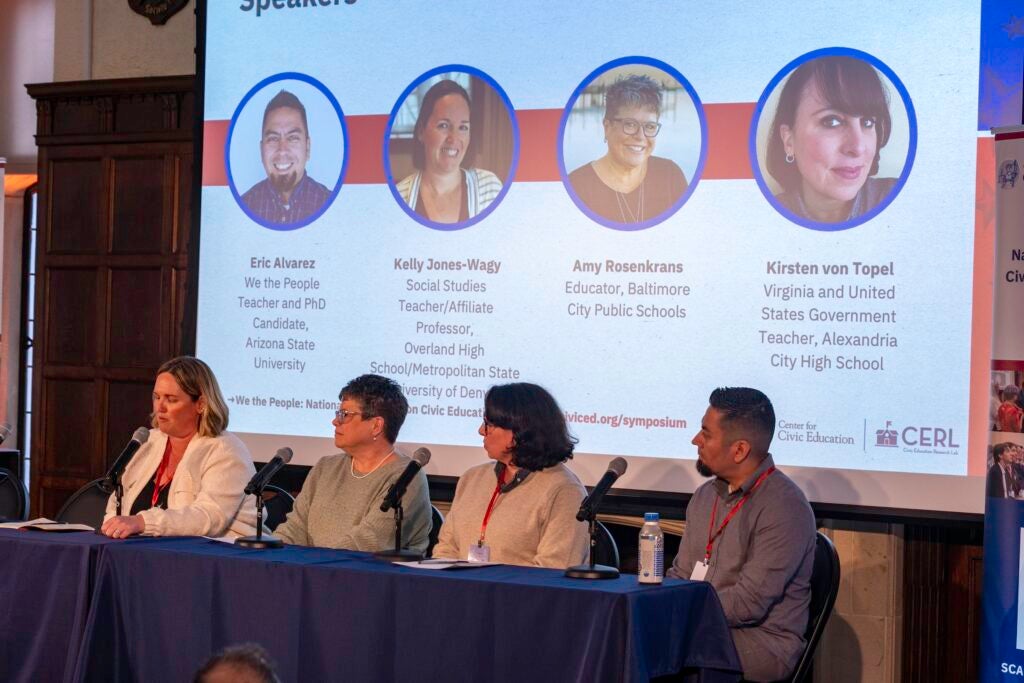
Taja Butler, Center for Civic Education, Eric Alvarez, Arizona State University; Kelly Jones-Wagy, Overland High School; Amy Rosenkrans, Baltimore City Public Schools; Kirsten von Topel, Alexandria City High School
Teachers working with English language learners adapt and refine instruction to meet the needs of increasingly diverse classrooms. Panelists demonstrated how civic learning can be made both accessible and rigorous through intentional design in contexts that included classrooms with dozens of languages and students with varied educational backgrounds.
Effective instruction begins with meeting students where they are. Teachers described designing lessons that prioritize access to content while supporting language development, using strategies such as structured discussion, collaborative learning, and real-world connections to make civic concepts meaningful. When students can connect to the material, they are more willing to engage, participate, and develop both content knowledge and language skills.
“They could start learning the information a lot more if they could access the content and engage with it and feel like somehow it was connected to them.”
– Kelly Jones-Wagy
Panelists also emphasized the importance of flexibility and creativity. English learners do not fit into a single category, and their needs can vary widely across speaking, reading, and comprehension. As a result, teachers regularly adapt materials, modify roles, and create multiple entry points into the curriculum. This work is not about simplifying content, but about designing instruction so that all students can participate in complex thinking and communication.
Panelists described several ways to support students during simulated hearings. Amy Rosenkrans gave students specific tasks, such as offering one key idea to strengthen the group’s work. Kelly Jones-Wagy allowed a student to use Google Translate to better understand judges’ questions and contribute an answer. Eric Alvarez highlighted sentence starters as a useful support not only for English learners, but also for all students. These approaches made it easier for English learners to participate in complex civic thinking and discussions.
Kirsten von Topel highlighted how mentor teachers, state coordinators, and the other teachers who were a part of her professional learning supported her as she adapted instruction to broaden access without compromising rigor. The resources and support provided by the Center help teachers cultivate classrooms where students develop the skills and confidence to participate fully in civic life.
Return to Session Summaries
Watch the Promising Practices in Civic Education for English Learners presentation:
Video link: https://www.youtube.com/live/30QpTDGKkJQ?si=Hi-fqv4ktK7alC8e&t=19821