

What Drives Civic Learning? K-12 and the Academy in Conversation
Posted in James Madison Legacy Project Expansion We the People: National Symposium on Civic Education
Judithanne McLauchlan, University of South Florida; Jason Giersch, University of North Carolina at Charlotte; Alina Lewis, Youth Civic Connections Project; Kimberly Mealy, American Political Science Association; Erin E. Mendelson, Central Oahu School District; Austin Trantham, Saint Leo University
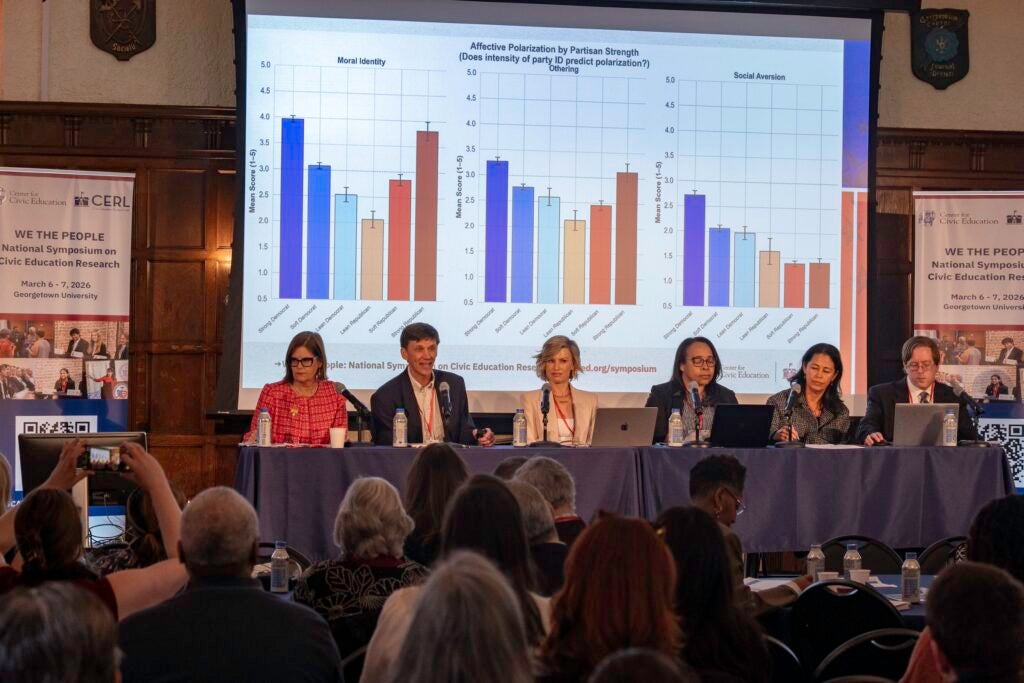
The growing collaboration between K–12 educators and higher education can strengthen civic learning across the educational pipeline. Moderated by Judithanne McLauchlan, the panel emphasized that preparing students for civic life requires sustained partnerships that connect research, teaching, and practice.
Jason Giersch presented research showing that his students report comfort with many forms of diversity, but are much less comfortable with political diversity. For Giersch, this suggests that civic education should give students opportunities to wrestle with moral complexity, competing principles, and political disagreement rather than avoiding difficult topics.
Alina Lewis described the Youth Civic Connections Project, which brings students from politically and geographically different communities together for structured discussions on issues such as abortion, gun control, immigration, and media literacy. Students prepare through shared readings, classroom lessons, discussion norms, and rapport-building before entering student-led breakout conversations. The project shows how carefully facilitated discussion can help students see disagreement as civil, nuanced, and shaped by different life experiences.
Kimberly Mealy emphasized the role the American Political Science Association plays in connecting K–12 educators with the civic education research community. She highlighted APSA resources such as teaching and learning webinars, a civic education book series, the Teaching and Learning Conference, and an online library of political science teaching materials. These resources help make research, instructional tools, and professional networks more accessible to educators.
Erin E. Mendelson grounded the discussion in teachers’ professional learning. She described how summer institutes and university experts helped her build the content knowledge, vocabulary, and confidence needed to lead civic conversations in her classroom, including conversations shaped by the relationship between Hawaiian sovereignty and U.S. constitutional history. Her remarks underscored the importance of treating teachers as professionals and giving them time, resources, and networks to strengthen their practice.
Austin Trantham showed how partnerships can extend beyond classrooms and campuses into local government. He described the Cumberland County Civics Club, where high school students mirror the structure of county government, work with local officials, and deliberate on real community issues. Students helped advance a splash pad project by meeting with companies, considering land and budget questions, and identifying stakeholders. The example illustrated a broader lesson from the panel: civic education is strongest when students are trusted with authentic opportunities to participate.
Return to Session Summaries
Watch the What Drives Civic Learning? presentation:
Video link: https://www.youtube.com/live/4pHBfDpJdg0?si=K5T_P5hjibVCYHF-&t=12002