

Civics that Sticks: The Power of Experiential Civic Learning
Posted in James Madison Legacy Project Expansion We the People: National Symposium on Civic Education
Michael Blauw, Center for Civic Education; Rachel Davison Humphries, Bill of Rights Institute; Verneé Green, Mikva Challenge; Meg Heubeck, University of Virginia; Cathy Ruffing, Street Law
by Michael Blauw
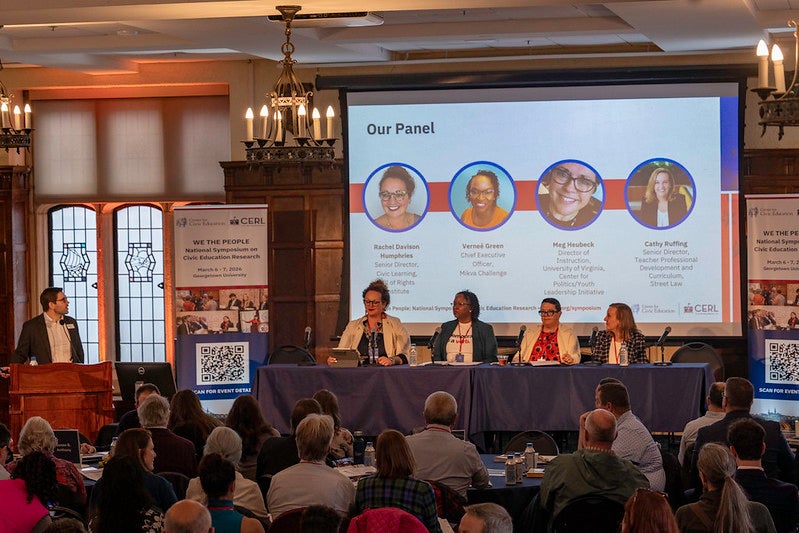
While continuing to highlight the We the People program and the Center’s work on providing civic learning experiences, this panel brought together four leaders from sister organizations, each offering their own approach to experiential civic learning. Together, they explored what makes experiential civic learning uniquely powerful.
Moderator Michael Blauw opened the session by introducing the National Task Force on Experiential Civic Learning as a new body of work from Educating for American Democracy. The task force recently released a white paper, “Experiential Civic Learning for American Democracy”.
The Task Force included panel members and drew together researchers, practitioners, and civic education leaders to define the field, examine the evidence base, and make the case for prioritizing experiential approaches in schools and communities across the country. The white paper articulates a framework for understanding experiential civic learning, and distinguishes it from passive instruction by its emphasis on authentic practice, student agency, and the development of civic dispositions alongside civic knowledge. The paper served as the conceptual foundation for the panel’s two organizing questions.
1) What makes experiential civic learning uniquely powerful?
Panelists offered distinct but complementary perspectives. Rachel Davison Humphries of the Bill of Rights Institute explored the pedagogies of a free society — including the often-overlooked role of hidden curriculum and the transformative potential of authentic learning experiences that connect constitutional principles to students’ real lives. Verneé Green of the Mikva Challenge highlighted how student voice and project-based learning give young people genuine agency in civic life. Meg Heubeck of the University of Virginia’s Center for Politics and Youth Leadership Initiative described her organization’s approach to meeting student skepticism with programs designed to build real confidence to act. Cathy Ruffing of Street Law made the case for grounding civic learning in the actual practice of law — through Legal Career Pathways, Moot Court, and Mock Trial programs that use current Supreme Court cases to make constitutional reasoning both authentic and consequential.
2) What are the biggest barriers — and what can we do about them?
The second round of discussion surfaced honest challenges: the vulnerability teachers feel navigating contested civic topics in today’s climate, the difficulty of attracting and retaining educators willing to do this demanding work, and the gap between the professional learning teachers need and what most schools and systems provide. Panelists pointed to coaching models, community-based learning, and creative use of technology as promising pathways. The panel concluded by affirming that experiential civic learning is necessarily local and diverse in nature, and that federalism is a feature of the field, not a bug. And, like any other skill, to be properly developed, civic learning experiences must be practiced constantly and in different contexts in order to equip young people for a role in self-government.
Return to Session Summaries
Watch the Civics that Sticks: The Power of Experiential Civic Learning presentation:
Video link: https://www.youtube.com/live/30QpTDGKkJQ?si=EkYMlEpQ6-0gX8sv&t=25218