

Breakthroughs in Civic Education Research
Posted in James Madison Legacy Project Expansion We the People: National Symposium on Civic Education
William O’Brochta, Texas Lutheran University; Tara Bartlett, Arizona State University; Emma Humphries, iCivics; David Kidd, Harvard University; Joshua M. Scacco, University of South Florida
By William O’Brochta
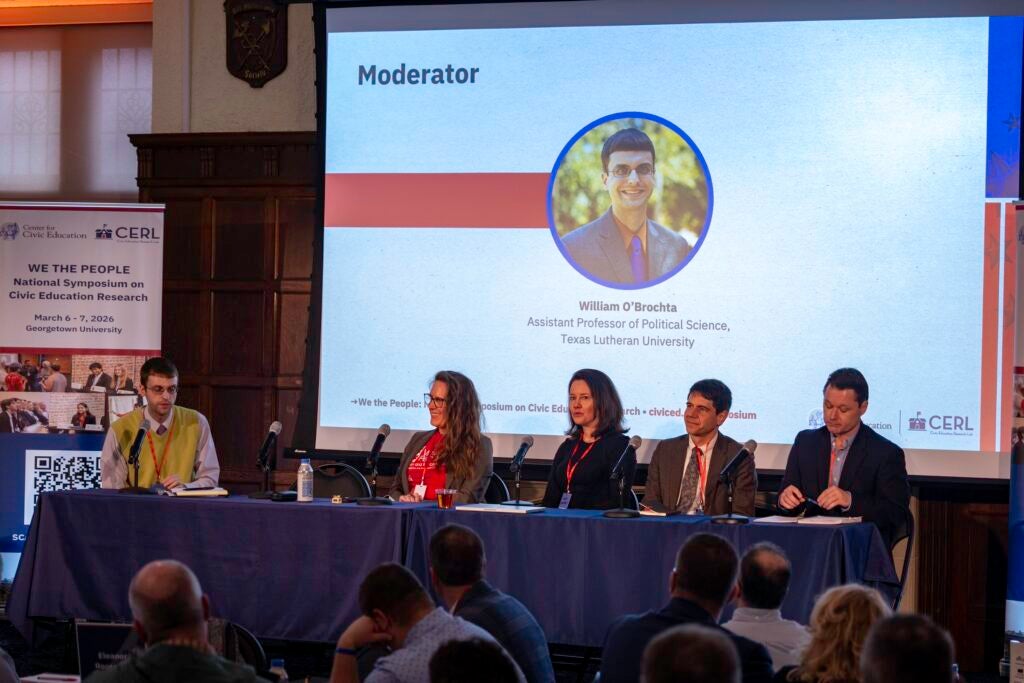
Much of the conference focused on the evidence-based We the People curriculum and assessment that resulted from a partnership between K-12 teachers, the Center for Civic Education, and the Civic Education Research Lab. The “Breakthroughs in Civic Education Research” session expanded the scope of this discussion to other evidence-based practices and programs that teachers may wish to adopt. Panelists converged on the common idea that implementing civic education research in a classroom requires a structured and systematic approach. Adopting a curriculum, using high-quality instructional materials, and providing professional learning opportunities are all important. However, these strategies do not necessarily lead to improved civic education outcomes.
The first step that Joshua Scacco, Ph.D., described in devising this structured and systematic approach is understanding the local political context and key indicators of youth political socialization. Given such an understanding, David Kidd, Ph.D., discussed the importance of developing authentic assessments that fit the learning outcomes of civic education in the local context. These assessments can take a variety of forms, but pre- and post-test surveys and within-curriculum checks are common. Setting up an assessment structure coincides with selecting a curriculum, establishing learning outcomes, choosing educational materials, and establishing professional learning opportunities. Emma Humphries, Ph.D., showed evidence that these program inputs and even immediate program outputs are not necessarily directly linked to desired civic education outcomes. How the curriculum is taught, the extent to which the civic education components are clearly signposted, and the ways in which the curriculum is relevant to students in their local context are all ways to improve this linkage. Using the classroom and/or school as the site of democratic participation — as Tara Bartlett, Ph.D., presented through a participatory budgeting project — can make civic education relevant and integrated. Each approach to using civic education research focused on carefully defining and measuring objectives and outcomes to ensure the effectiveness of an intervention.
Though this approach can and should be adopted at the state, school district, and individual school level, teachers working in settings without an emphasis on civic education can and should still take meaningful steps to use evidence-based approaches to civic education that are systematically designed, formally assessed, and locally tailored. The best such interventions are appropriately sized so that the individual teacher has the capacity to implement the intervention and the capacity to do the necessary preparation and assessment work to determine its success. Professional learning opportunities emphasizing utilizing civic education research as a process of continuous learning and improvement can support teachers and supplement a focus on curriculum and high-quality instructional materials. It is also important for teachers and civic education researchers to be willing to engage and meaningfully collaborate as partners in improving civic education. New and innovative research is most applicable if it is inspired by teachers and addresses clear student and classroom needs.
Return to Session Summaries
Watch the Breakthroughs in Civic Education presentation:
Video link: https://www.youtube.com/live/30QpTDGKkJQ?si=zSQYwI-LXKl6G7P2&t=21857