

Promising Practices in Civic Education for Students with Disabilities
Posted in James Madison Legacy Project Expansion We the People: National Symposium on Civic Education
Anna Ballard, Center for Civic Education; Michelle Argent, Baltimore Lab School; Amanda Fay, Berkeley Middle School; Christine Hull, Nevada Center for Civic Engagement
Civic education programs like We the People can maintain rigor while remaining accessible to students with disabilities. This panel discussed how instructional approaches can support students with disabilities in meeting high expectations. Teachers described scaffolding key skills over time, including claim, evidence, and reasoning; structured discussion; and inquiry-based learning. By the time students reach simulated hearings, these practices are familiar. They also emphasized flexibility in implementation, such as differentiating roles, allowing varied forms of participation, and using universal design and experiential learning to make complex content accessible. Collaboration among teachers and support staff further strengthens this work.
“Experiential learning is the best part of learning because it gives all students the opportunity to learn at whatever level they can arrive at, and they all walk away with having done something and having been a part of it.”
– Christine Hull
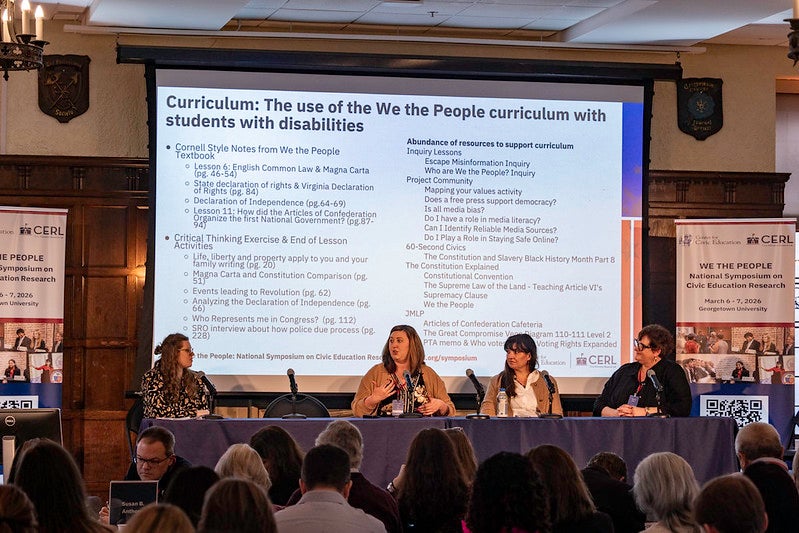
The panelists illustrated these approaches through classroom examples that brought the work to life. Michelle Argent described adapting the simulated congressional hearing into a reader’s theater, allowing students to engage with the hearing questions through performance and movement. Amanda Fay and Christine Hull shared examples of students contributing in different ways based on their strengths, including nonverbal students who participated through written responses and peer support during hearings. Across these examples, the goal was not to change the expectations, but to expand the ways students could meet them.
Ultimately, the session reinforced that rigor and inclusion in civic education are not competing goals. When aligned, they create classrooms where all students can engage in meaningful civic learning and see themselves as capable participants in democratic life.
Return to Session Summaries
Watch the Promising Practices for Civic Education for Students with Disabilities presentation:
Video link: https://www.youtube.com/live/30QpTDGKkJQ?si=HknO8pAFybjomzPV&t=12353