

Civic Education for All Students
Posted in James Madison Legacy Project Expansion We the People: National Symposium on Civic Education
Donna Phillips, Center for Civic Education
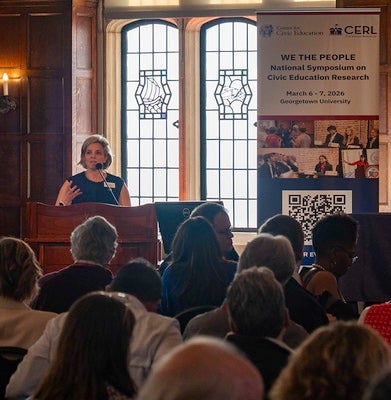
Civic education plays a critical role in preparing young people to participate meaningfully in democratic life. Yet for decades, it has been sidelined in schools in favor of tested subjects like math and literacy. This has limited students’ access to opportunities that foster not only civic knowledge, but also the skills and dispositions necessary for engaged citizenship.
At its best, civic education is not simply about learning facts. It is about experiencing democracy. Effective programs engage students in rigorous content while immersing them in collaborative, inquiry-based environments where they practice discussion, reasoning, and problem-solving. These experiences help students see themselves as active participants in a shared civic enterprise.
Classroom experiences from programs like We the People illustrate this potential. In one example, a middle school class conducting a simulated congressional hearing selected a student with learning disabilities as a team leader. With support from her peers, she helped engage another student who had previously disengaged. Students collaborated, refined their arguments, and worked toward a shared goal. The result was not only academic success, but also a shift in how students saw themselves and each other as capable contributors to a shared common endeavor.
These “citizenship moments” reflect what distinguishes high-quality civic education. When students deliberate, listen, and work toward common purposes, classrooms become spaces where democratic norms are practiced. Students develop the ability to engage in civil discourse, evaluate information, and understand their societal role.
“When students are asked to reason together towards a common outcome about a constitutional question, new civic competencies emerge, different voices are valued, and students begin to see themselves as contributors to a shared civic enterprise.”
– Donna Phillips
Not all civic education produces these democratizing outcomes. Programs that rely on passive learning or lack opportunities for authentic engagement are less likely to foster meaningful development. In contrast, approaches that combine content knowledge with experiential learning can transform both classroom dynamics and student outcomes.
Ensuring civic education for all requires more than expanding access to courses. It requires access to high-quality experiences that allow students to practice democracy in meaningful ways. This includes classrooms that are inclusive, collaborative, and grounded in inquiry.
Ultimately, civic education is essential not only for individual development, but also for the health of democracy itself.
Return to Session Summaries
Watch the Civic Education for All Students presentation:
Video link: https://www.youtube.com/live/30QpTDGKkJQ?si=87hWyOTOToP2v8wC&t=2522